When a Smartphone Outshines a Telescope: The Capture the Dark 2025 Revolution
For as long as humans have gazed upward, the night sky has been a source of wonder, mystery, and artistic inspiration. Yet, in the modern era of astrophotography, there has long been an unspoken barrier to entry. The prevailing belief was that to capture the cosmos in any meaningful way, one needed not just passion, but also a small fortune. The stereotype was painfully familiar: a shivering photographer huddled behind a computerized equatorial mount worth more than a used car, meticulously adjusting a telescope lens the size of a small cannon, all to capture a faint, ghostly smudge of light from a nebula millions of light-years away. This image of the astrophotographer as a dedicated, deep-pocketed specialist has dominated the field for decades, intimidating casual stargazers and young dreamers alike. However, the results of the Capture the Dark 2025 astrophotography contest have shattered this perception with the force of a supernova. The headline story from this year’s competition is not about a new multi-million-dollar observatory in Chile, nor about a cutting-edge cooled CMOS camera. Instead, it is about a twelve-year-old boy from Canada who proved that the universe does not require a pilgrimage to a mountaintop; it fits right in your pocket.
The Unlikely Champion: Siddharth Patel’s Moment of Clarity
At the heart of this paradigm shift stands Siddharth Patel, a twelve-year-old student from Ontario, who was recently announced as the winner of the prestigious People’s Choice Award. This category is particularly significant because it is decided not by a panel of seasoned experts, but by the general public—people who may know nothing about aperture sizes, focal ratios, or dark current noise. What they vote for is what moves them, what feels authentic, and what sparks their own imagination. While professional astronomers and seasoned hobbyists submitted entries taken with equipment worth tens of thousands of dollars—rigs that included automated filter wheels, guided tracking systems, and specialized astro-modded cameras—Siddharth captured his winning image using nothing more than his mother’s two-year-old smartphone.
The photograph is nothing short of breathtaking. It features a stunning comet blazing diagonally across the Ontario landscape, its icy tail streaming away from the sun like a celestial ribbon unfurled against the dark velvet of the sky. Below, the jagged silhouette of pine trees and a distant farmhouse anchor the image in earthly reality, creating a powerful contrast between the infinite and the intimate. What makes this achievement particularly resonant is the accessibility it represents. Siddharth did not have access to a motorized tracking mount to compensate for the Earth’s rotation, nor did he have a cooled camera sensor to reduce thermal noise during a long exposure. He did not use a star tracker, a light pollution filter, or any post-processing software beyond the basic editing tools built into his phone. He simply had a moment of clarity, a clear sky away from city lights, and a device that billions of people carry in their pockets every single day.
In interviews following the announcement, Siddharth humbly explained his process. He had noticed the comet’s predicted path on a free astronomy app and asked his mother to drive him to a nearby conservation area. He propped the phone against a rock, used the “night mode” feature, and waited for the right moment. After several attempts, one frame aligned perfectly: the comet, the trees, the silence of the countryside. His victory in the People’s Choice category is revolutionary because it suggests that viewers connected more deeply with the relatability and raw emotion of the image than with the technical perfection of high-end gear. It sends a clear message to the astrophotography community: wonder is not measured in megapixels.
The Cosmic Magic of Other Winners: A Symphony of Light
Yet, Siddharth’s victory does not diminish the technical prowess displayed by the other winners of the Capture the Dark 2025 contest. On the contrary, it complements it by showcasing the incredible diversity of the night sky and the many ways humans can interpret it. The competition was filled with what can only be described as pure cosmic magic, a gallery of images that remind us how dynamic and surprising our universe truly is. Among the standout entries was a breathtaking depiction of Comet C/2023 A3 (Tsuchinshan-ATLAS) , a rare visitor that graced our skies with a vibrant, bifurcated tail so bright it was visible to the naked eye even from suburban locations. While Siddharth captured a comet on a phone, other photographers utilized advanced stacking techniques—combining dozens or even hundreds of individual exposures—to reveal the intricate gas structures and dust lanes within the comet’s coma. These images showed the same celestial object but told a different story: one of scientific precision, patience, and technical mastery. The coexistence of both approaches in the same competition proves that astrophotography is not a zero-sum game; there is room for the artist and the scientist, the beginner and the expert.
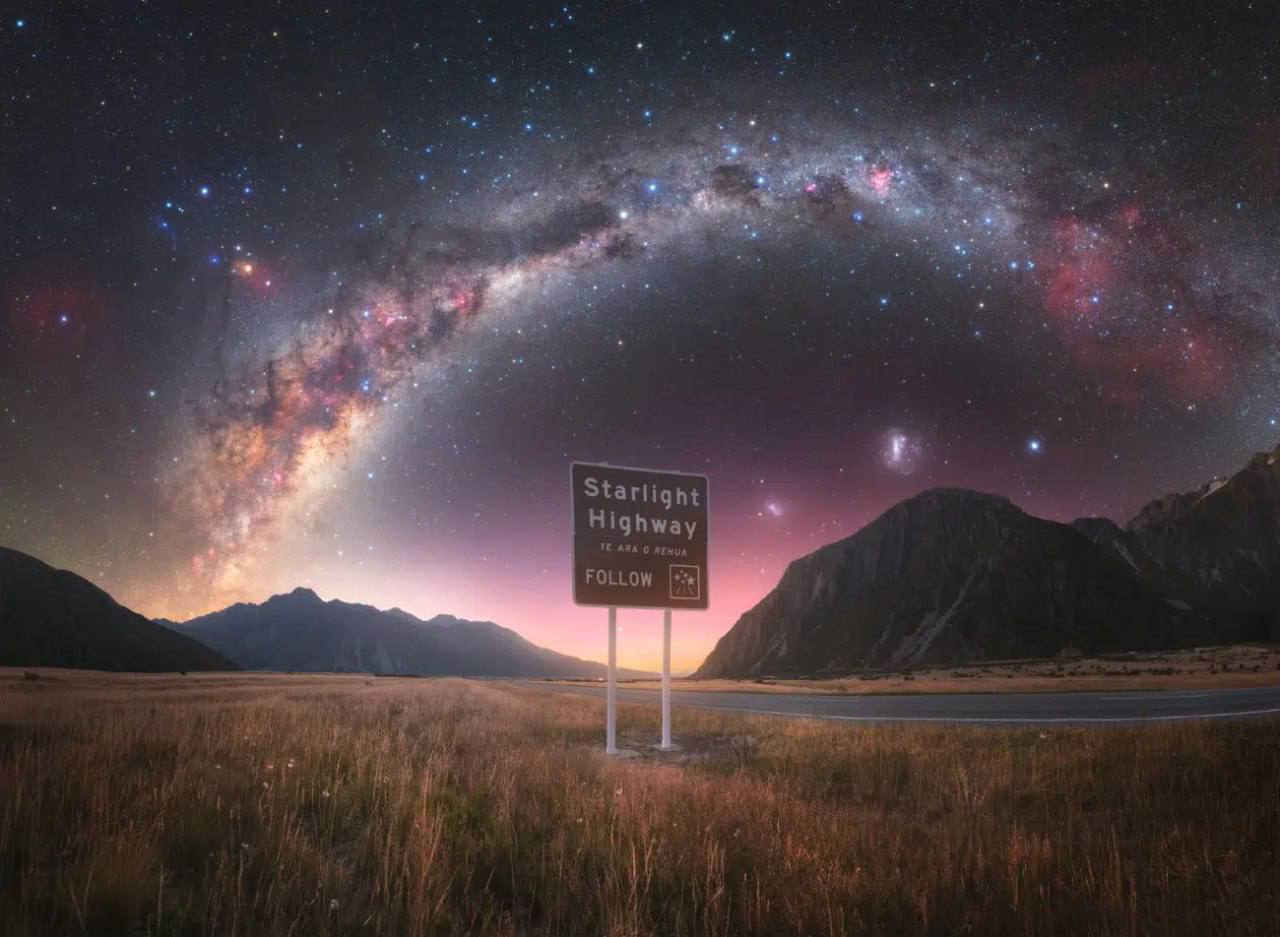
Another highlight was an image described by the judges as a “star highway.” This creative long-exposure shot, taken from a remote location in the Namibian desert, captured the rotation of the Earth turning stars into sweeping, circular lines of light that resembled a luminous celestial roadway leading toward the jagged horizon. Unlike deep-sky images that require tracking to keep stars as points of light, this entry deliberately embraced motion, emphasizing composition and artistic interpretation over raw data. It looked less like a scientific document and more like a painting, a testament to the photographer’s eye for design rather than their budget for optics.
Furthermore, the contest featured rare atmospheric phenomena that push the boundaries of what even professional gear can capture. One such category highlighted “red sprites” —elusive, large-scale electric discharges that occur high above thunderstorm clouds, often invisible to the human eye and incredibly difficult to photograph. Capturing a red sprite requires immense luck, precise timing, and a clear line of sight to a distant storm. Regardless of the camera used, the photographer must be in the right place at the right moment, often after hours of waiting in uncomfortable conditions. The winning sprite image, taken by a storm chaser from Kansas using a mid-range DSLR, was a ghostly crimson jellyfish-like shape hovering above a lightning-lit cloud anvil. It was a reminder that some of the universe’s most spectacular shows are not in distant galaxies, but right here in our own atmosphere, waiting for someone with patience to look up.
Additionally, a hauntingly beautiful shot of the Scorpius constellation under moonlight reminded viewers that sometimes the classic subjects, when framed with patience and creativity, remain the most powerful. The photographer had positioned themselves near a frozen lake in the Chilean Andes, allowing the reflection of stars to shimmer on the ice. The reddish supergiant Antares, the heart of the scorpion, burned like a dying ember just above the mountain peaks. This image required no expensive narrowband filters; it required only a clear night, a tripod, and an appreciation for the ancient stories written in the stars. These entries collectively proved that while gear varies—from smartphones to observatory-grade telescopes—the sense of wonder remains constant, universal, and deeply human.
The Democratization of the Night Sky
The results of the Capture the Dark 2025 contest signal something far larger than a single competition. They point to a broader democratization of astronomy and photography, a shift that has been accelerating over the past decade. We are living in an era where computational photography has bridged the gap between amateur and professional in ways that were unimaginable even five years ago. Modern smartphones are no longer simple cameras; they are miniature computers equipped with artificial intelligence that can stack multiple exposures instantly, align frames to compensate for hand shake, reduce noise algorithmically, and enhance low-light performance using machine learning models trained on millions of images. These are precisely the techniques that professionals used to spend hours executing in post-processing software like Photoshop or PixInsight. Now, a child can achieve comparable results with a single press of a button.
This technological leap means that the barrier to entry is no longer financial. It is no longer about saving for years to buy a tracking mount or a fast lens. Instead, the barrier has shifted to something far more equitable: education and motivation. The message from Capture the Dark 2025 is clear and unambiguous: it is not always about the $10,000 camera. Sometimes, it is just about timing, location, and most importantly, vision. The “gatekeeping” that often plagues niche hobbies—the subtle (or not-so-subtle) implication that real astrophotography requires expensive gear and years of training—is rapidly dissolving. It is being replaced by a vibrant, inclusive community that values the story behind the shot as much as the pixel count. Online forums, social media groups, and free tutorial videos have empowered a new generation of creators who might never set foot in a professional observatory but who can capture the Milky Way from their backyard.
A Beacon for Young Dreamers
Ultimately, the Capture the Dark 2025 contest serves as a powerful reminder that we are all living under the same sky, regardless of the tools we use to observe it. Siddharth Patel’s win is a beacon of inspiration for young aspiring scientists and artists who might feel intimidated by the cost of equipment or the complexity of the craft. It validates the radical but beautiful idea that curiosity, not capital, is the true engine of discovery. When a smartphone beats a telescope in a popularity contest, it does not mean that telescopes are obsolete. It does not mean that professional gear is worthless. On the contrary, it means that the magic of the cosmos is no longer locked behind a paywall. It means that the night sky belongs to everyone.
The revolution sparked by Capture the Dark 2025 is not about replacing high-end tools with phones; it is about expanding the circle of who gets to participate in the ancient human tradition of looking up and asking, “What is out there?” The next time you find yourself under a dark sky—whether on a camping trip, a rural road, or even a suburban balcony—do not feel compelled to wait until you can afford the perfect gear. Do not convince yourself that your equipment is not good enough. Look up, take out your phone, steady it against a rock or a fence post, and press the shutter. You might be surprised by what you capture. Remember that the universe is vast, beautiful, ancient, and waiting. It does not ask for your credentials, your budget, or your experience. It only asks that you look. And as a twelve-year-old boy with a smartphone has just proven to the world, sometimes that is more than enough.
Your one-stop shop for automation insights and news on artificial intelligence is EngineAi.
Did you like this article? Check out more of our knowledgeable resources:
Watch this space for weekly updates on digital transformation, process automation, and machine learning. Let us assist you in bringing the future into your company right now